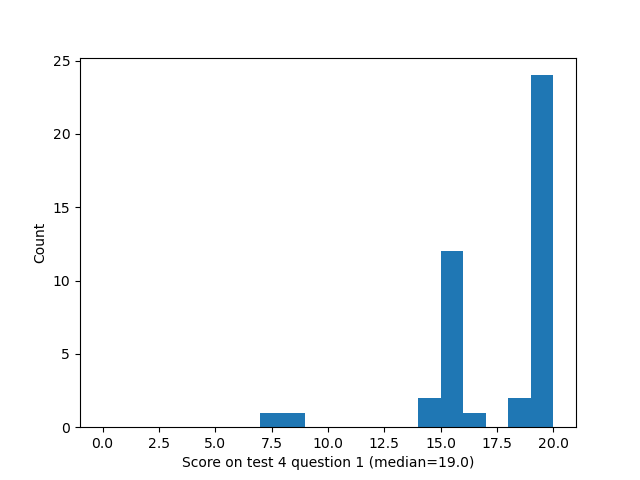
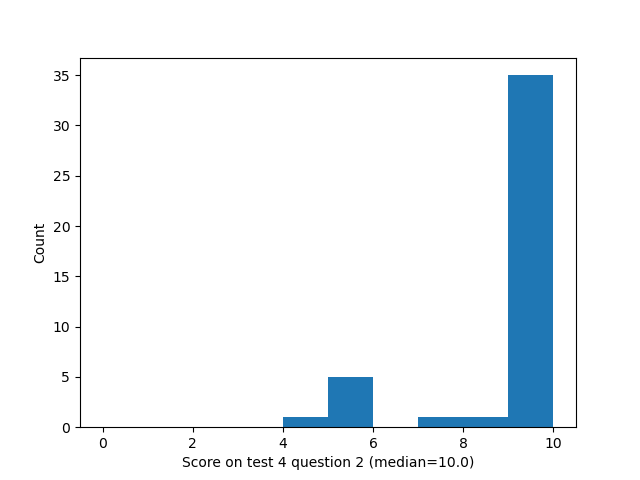
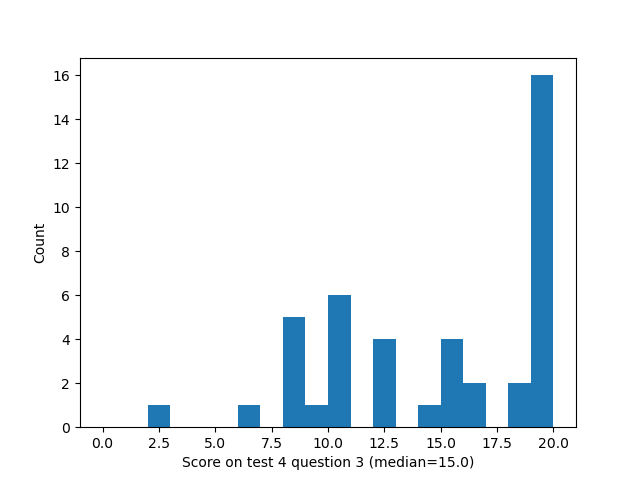
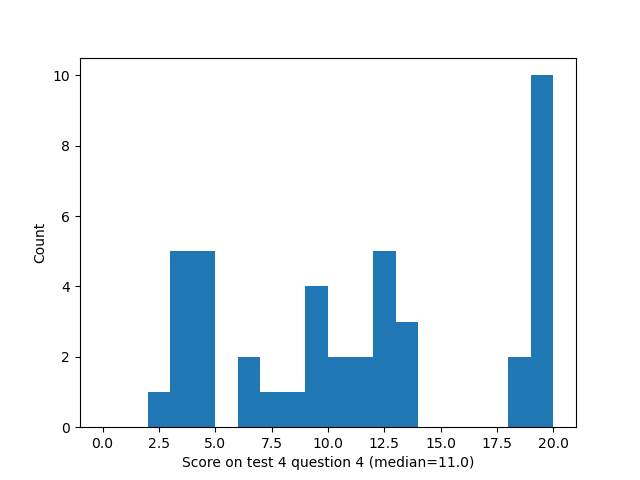

for MATH 3300 and 5300 Calculus III, Spring 2025-26.
Set up and evaluate the double integral to find the
volume
between \(f_1(x,y)=\sin(x)\cos(y)\) and
\(f_2(x,y)=\cos(x)\sin(y)+2\)
over the triangle with corners \((0,0)\), \((\pi,0)\), and \((\pi,\pi)\).
[14.6 #7] \[\begin{aligned} \int_{0}^{\pi} \int_{0}^{x} \left(f_2(x,y)-f_1(x,y)\right)dydx &= \int_{0}^{\pi} \int_{0}^{x} \left(\cos(x)\sin(y)+2-\sin(x)\cos(y)\right)dydx\\ &= \int_{0}^{\pi} \left. -\cos(x)\cos(y)+2y-\sin(x)\sin(y) \right|_{0}^{x} dx\\ &= \int_{0}^{\pi} \left( -\cos(x)\cos(x)+2x-\sin(x)\sin(x) \right) - \left( -\cos(x)\cos(0)+0-\sin(x)\sin(0) \right) dx \\ &= \int_{0}^{\pi} -1+2x +\cos(x) dx = \left. -x + x^2 + \sin(x)\right|_{0}^{\pi} = -\pi + \pi^2 +0 -0 = \pi^2-\pi\,. \end{aligned}\]
Set up the iterated integral to compute the surface area of the
graph of \(f(x,y)=x^2-y^3\)
over the rectangle with opposite corners \((2,3)\) and \((5,7)\). (You do not need to compute the
integral.)
[similar to 14.5 #9] Computing \(f_x(x,y)=2x\) and \(f_y(x,y)=-3y^2\), the surface area is \[\iint_R \sqrt{1+f_x(x,y)^2+f_y(x,y)^2}\, dA =\int_{2}^{5} \int_{3}^{7} \sqrt{1+(2x)^2+(-3y^2)^2} dy dx\,.\]
Using spherical coordinates, find the mass of a ball of radius
2 centered at the origin
with density function \(\delta(x,y,z)=x^2 +
y^2 + z^2\).
[similar to 14.7 #33] Recalling that \(\rho = \sqrt{x^2+y^2+z^2}\), the density simplifies to \(\delta = \rho^2\). Since the region is a ball of radius 2, we have \(\phi\in [-\pi/2,\pi/2]\), \(\theta\in [0,2\pi]\), and \(\rho\in [0,2]\). Recalling that \(dV= \rho^2\cos(\phi) d\rho d\theta d\phi\), our integral is thus \[\begin{aligned} \iiint_B (x^2 + y^2 + z^2) \ dV &= \int_{-\pi/2}^{\pi/2}\int_{0}^{2\pi}\int_{0}^{2} \rho^4\cos(\phi) d\rho d\theta d\phi\\ =& \int_{-\pi/2}^{\pi/2}\int_{0}^{2\pi} \left.\frac{\rho^5}{5}\cos(\phi)\right|_{0}^{2} d\theta d\phi = \frac{2^5}{5}\int_{-\pi/2}^{\pi/2}\int_{0}^{2\pi} \cos(\phi) d\theta d\phi\\ =& \frac{2^6\pi}{5} \int_{-\pi/2}^{\pi/2}\cos(\phi) d\phi =\frac{2^6\pi}{5}(\sin(\pi/2)-\sin(-\pi/2))= \frac{2^7\pi}{5} \end{aligned}\]
Use the transformation \(y-x=u\) and \(x+y=v\) to evaluate \[\iint_R \sin(x-y)dA\] on the square \(R\) determined by the lines \(y=x\), \(y=-x+2\), \(y=x+2\), and \(y=-x\).
(\(R\) has corners \((0,0)\), \((1,1)\), \((-1,1)\), and \((0,2)\).)
[openstax 5.7 #393] Solving the system \(y-x=u\) and \(x+y=v\) for \(x\) and \(y\) gives \(x=(v-u)/2\) and \(y=(u+v)/2\), so the Jacobian is \[J(u,v) = \begin{vmatrix} \frac{\partial x}{\partial u} & \frac{\partial y}{\partial u}\\ \frac{\partial x}{\partial v} & \frac{\partial y}{\partial v} \end{vmatrix} = \begin{vmatrix} -1/2 & 1/2 \\ 1/2 & 1/2 \end{vmatrix} = \frac{-1}{2}\frac{1}{2} - \frac{1}{2}\frac{1}{2} = -\frac{1}{2}\] and the integrand is \[\sin(x-y) = \sin((v-u)/2-(u+v)/2) = \sin(-u)\,.\] The transformation is linear and the corners go to \((0,0)\), \((0,2)\), \((2,0)\), and \((2,2)\), so \(S\) is the square \(0\le u \le 2\) and \(0\le v \le 2\). Putting this all together, we have \[\iint_R \sin(x-y)dA = \int_{0}^{2} \int_{0}^{2} \sin(-u) \left|-\frac{1}{2}\right|dudv =\frac{1}{2} \int_{0}^{2} \left. \cos(-u) \right|_0^2 dv =\frac{1}{2} \int_{0}^{2} \cos(-2) -1 dv =\cos(-2)-1\,.\]
The parameterized curve \(\vec r(t) =
\langle \cos(t),\sin(t), t\rangle\) for \(0\leq t\leq 4\pi\) follows a thin
wire
with density \(\delta(x,y,z) = z\).
[15.1 #19]
Find the mass (\(M\)) of this wire.
From the parameterization, we compute \[\begin{aligned} \vec{r}'(t) &= \langle -\sin(t),\cos(t), 1\rangle,\quad \text{so}\\ \|\vec{r}'(t)\| &= \sqrt{ \sin^2(t)+\cos^2(t)+ 1}=\sqrt{2}\,. \end{aligned}\] Noting \(\delta(x,y,z) = z =t\), \[M = \int_{0}^{4\pi} t \sqrt{2} dt = \left. \frac{t^2}{2}\sqrt{2} \right|_{0}^{4\pi} = \frac{(4\pi)^2}{2}\sqrt{2} = 8\sqrt{2}\pi^2.\]
Write the integrals for the three moments of this wire. (You do not need to compute the integrals.)
\[ M_{yz}= \int_{0}^{4\pi} \cos(t) t \sqrt{2} dt, \quad M_{xz}= \int_{0}^{4\pi} \sin(t) t \sqrt{2} dt, \quad M_{xy}=\int_{0}^{4\pi} t t \sqrt{2} dt \]Write the expression for the center of mass of the wire in terms of \(M\), \(M_{yz}\), \(M_{xz}\), and \(M_{xy}\).
\[(\overline{x},\overline{y},\overline{z}) = \left(\frac{M_{yz}}M, \frac{M_{xz}}M,\frac{M_{xy}}M\right)\text{.}\]
Compute the divergence and curl of the vector field \(\displaystyle\vec F = \langle x^2+z^3,x^5+y^7,y^9+z\rangle\).
[similar to 15.2 #14] \[\mathrm{div}\vec F =\nabla\cdot \vec F = 2x+7y^6+1\] \[\mathrm{curl}\vec F =\nabla\times \vec F = \langle P_y-N_z,M_z-P_x,N_x - M_y\rangle = \langle 9y^8-0, 3z^2-0,5x^4-0 \rangle = \langle 9y^8, 3z^2,5x^4 \rangle\]
Last modified: Wed Apr 15 12:29:59 UTC 2026