Given that \(z=5x+2y\), \(x=2\cos(t)+1\), and \(y=\sin(t)-3\), find the value(s) of \(t\) where \(\frac{dz}{dt}=0\). (Since you do not have a calculator, leave your answer as some expression \(t=\dots\).)
[13.5 #15] \[\frac{dz}{dt} =\frac{\partial z}{\partial x}\frac{dx}{dt}+\frac{\partial z}{\partial y}\frac{dy}{dt} = 5 (-2\sin(t)) + 2(\cos(t)) \overset{\text{set}}{=} 0 \Rightarrow \tan(t) = \frac{1}{5} \Leftrightarrow t= \arctan(1/5).\]
Given that \(\frac{\partial z}{\partial x}=2\), \(\frac{\partial z}{\partial y}=3\), \(\frac{\partial x}{\partial s}=5\), \(\frac{\partial x}{\partial t}=7\), \(\frac{\partial y}{\partial s}=11\), \(\frac{\partial y}{\partial t}=13\), find \(\frac{\partial z}{\partial t}\).
[similar to 13.5 #30] \[\frac{\partial z}{\partial t} = \frac{\partial z}{\partial x}\frac{\partial x}{\partial t} + \frac{\partial z}{\partial y}\frac{\partial y}{\partial t} = 2\cdot 7 + 3\cdot 13 = 14+39=53.\]
Let \(f(x,y) = -x^2y+xy^2+xy\) and \(P=(2,1)\).
[similar to 13.6 #19]
Find the direction of maximal increase of \(f\) at \(P\).
\[\nabla f(x,y) = \langle -2xy+y^2+y, -x^2+2xy+x \rangle \Rightarrow \nabla f(2,1) = \langle -4 +1+1 , -4+4+2 \rangle = \langle -2 ,2 \rangle .\]
What is the maximal value of \(D_{\vec{u}}f\) at \(P\), where \(\vec{u}\) is a unit vector?
\[\|\nabla f(2,1)\|=\|\langle -2 ,2 \rangle\|=\sqrt{(-2)^2+2^2}=\sqrt{8}.\]
Give a unit vector \(\vec{u}\) such that \(D_{\vec{u}}f=0\) at \(P\).
We need \(\vec{u}\cdot \nabla f(2,1)=\vec{u}\cdot \langle -2 ,2 \rangle=0\), which is satisfied by any nonzero multiple of \(\langle 1 ,1 \rangle\). Dividing by its norm, the two possible unit vectors are \(\vec{u} = \pm \langle 1/\sqrt{2} ,1/\sqrt{2} \rangle\).
Consider the surface \(2x^2+y^2+3z^2=10\) and the point \(P=(-1,1,2)\).
[similar to 13.7 #21]
Find an equation for the normal line to the surface at \(P\).
Consider the surface as the level surface of a function \(f(x,y,z)\) and compute the gradient \[\nabla f(x,y,z) = \langle 4x, 2y, 6z \rangle.\] The gradient is orthogonal to the surface, so an equation for the normal line is \[l(t) = \langle -1,1,2 \rangle + t \nabla f(-1,1,2) =\langle -1,1,2 \rangle + t \langle -4,2,12 \rangle.\] (Note: The 10 in the problem statement should have been 15, so that the point was on the surface.)
Find an equation for the plane tangent to the surface at \(P\).
The gradient and point also give an equation for the tangent plane \[\nabla f(-1,1,2) \cdot \overrightarrow{P(x,y,z)}= -4(x-(-1))+2(y-1)+12(z-2)=0.\]
Find the critical points of the function \(f(x,y)=x^3y+12x^2-8y\). Use the Second Derivative Test to determine if each critical point corresponds to a relative maximum, minimum, or saddle point.
[similar to 13.8 #12] Compute the gradient \[\nabla f(x,y) = \langle 3x^2y+24x, x^3-8\rangle\] and set equal to \(\langle 0,0\rangle\). The second component gives \(x^3-8=0\) so \(x=2\). Plugging into the first component gives \(12y+48=0\) so \(y=-4\). The second partial derivatives are \[f_{xx}(x,y)=6xy+24,\quad f_{yy}(x,y)=0,\quad \text{and } f_{xy}(x,y)=3x^2,\] so \[D(x,y)=(6xy+24)(0)-(3x^2)^2\quad\text{and } D(2,-4)=-(3 (2^2))^2 <0,\] which means there is a saddle point a \((2,-4)\).
Use the method of Lagrange multipliers to find the maximum and
minimum values of the function
\(f(x,y)=y^2-x^2\) subject to the
constraint \(\frac{1}{4}x^2+y^2=1\).
[Similar to openstax 4.8 #365] Setting \(g(x,y)=\frac{1}{4}x^2+y^2-1\), we have \[\nabla f(x,y)= \langle-2x,2y\rangle\text{ and } \nabla g(x,y)=\left\langle\frac{1}{2}x,2y\right\rangle,\] so our equations are \[-2x = \lambda \frac{1}{2}x, \quad 2y= \lambda 2y,\text{ and } \frac{1}{4}x^2+y^2-1=0.\] The first equation implies either \(\lambda=-4\) or \(x=0\). If \(\lambda=-4\), then the second equation implies \(y=0\) and then the third equation implies \(x=\pm 2\); thus we have candidate points \((2,0)\) and \((-2,0)\). If \(x=0\), then the second equation implies \(\lambda=1\) and the third equation implies \(y=\pm 1\); thus we have candidate points \((0,1)\) and \((0,-1)\). Plugging in these 4 points gives \[f(2,0)= -4,\quad f(-2,0)=-4,\quad f(0,1)= 1, \text{ and} f(0,-1)= 1.\] So, the maximum value is 1 and the minimum value is -4.
Consider the iterated integral \(\displaystyle \int_{-2}^{2}\int_{0}^{4-x^2} dydx\). (You do not need to compute the integral.)
[14.1 #17]
Sketch the region whose area it computes.
![region under 4-x^2 for x in [-2,2]](t14_3region.png)
Switch the order of integration to give another iterated integral that computes the same area. (You do not need to compute the integral.)
\[\int_{0}^{4}\int_{-\sqrt{4-y}}^{\sqrt{4-y}} dxdy\]
Compute the iterated integral \(\displaystyle \int_{1}^{2}\int_{y}^{3}(x^2y-\cos(x))dx\, dy\). (You do not need to simplify your answer.)
[similar to 14.2 #8] \[\begin{aligned} &=\int_{1}^{2}\left.\left(\frac{1}{3}x^3y-\sin(x)\right)\right|_{y}^{3} dy =\int_{1}^{2}\left(\left(9y-\sin(3)\right) -\left(\frac{1}{3}y^4-\sin(y)\right) \right)dy\\ &=\int_{1}^{2}\left(9y-\sin(3) -\frac{1}{3}y^4+\sin(y)\right)dy = \left. \frac{9}{2}y^2 -\sin(3)y -\frac{1}{15}y^5-\cos(y) \right|_{1}^{2}\\ &= \frac{9}{2}2^2 -\sin(3)2 -\frac{1}{15}2^5-\cos(2) -\left(\frac{9}{2} -\sin(3) -\frac{1}{15}-\cos(1)\right) \end{aligned}\]
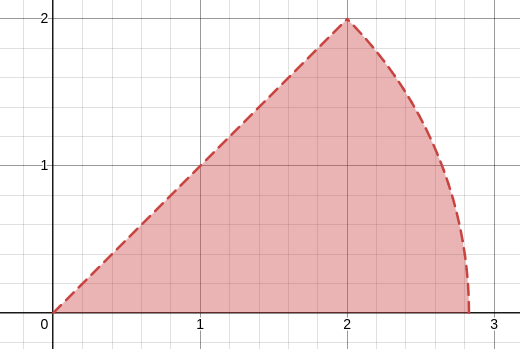
Consider the integral \(\displaystyle \int_{0}^{2} \int_{y}^{\sqrt{8-y^2}} (x+y)dx\,dy\). (You do not need to compute the integral.)
[similar to 14.3 #13]
Sketch the region that is being integrated over.
Rewrite the integral in polar coordinates. (You do not need to compute the integral.)
The region is a sector of a disc, with \(0\le \theta \le \pi/4\) and \(0\le r \le \sqrt{8}\). We thus get \[\begin{aligned} & \int_{0}^{\pi/4} \int_{0}^{\sqrt{8}} (r\cos(\theta)+r\sin(\theta))rdr\,d\theta \end{aligned}\]