On weeks of tests, the recitation will consist of test review and open time for questions. In the remaining 10 weeks, recitations will typically consist of:
If you miss the recitation, then you may turn in the groupwork as an individual by class on the following Monday, but it will have a 25% late penalty.
You may be absent for up to three (3) days each academic semester, without penalty, to take time off for reasons of faith or religious or spiritual belief system or to participate in organized activities conducted under the auspices of a religious denomination, church, or other religious or spiritual organization. You are required to notify me in writing of specific dates requested for alternative accommodations no later than fourteen (14) days after the first day of instruction. These requests will remain confidential. For more information about this policy, contact the office of Civil Rights Compliance.
| How to be successful at Calculus | How to be unsuccessful at Calculus |
|---|---|
| Have a growth mindset: believe that through effort you can improve your mathematical skills. | Have a fixed mindset: believe that your mathematical skills are set, so effort is either unneccessary or futile. |
| Show up and do the work. | Skip stuff. Start with an occasional class, then a recitation, then some homework, ... |
| Figure out the solutions to activities and exercises. | Find the solutions to activities and exercises by copying from classmates, looking at posted answers, searching the internet, asking AI, etc. |
| Be active in class: think, write, talk, do, ... | Be passive (or distracted) in class, waiting for learning to somehow happen. |
| Read the book. Carefully. Multiple times. | Don't read the book. Make excuses like "It is too confusing.", "I learn better from videos.", or "The instructor should tell me everything I need to know in class." |
| Do the exercises in the text. | Ignore the exercises in the text. Convince yourself that since it is not collected it must not be important. |
| Strive for mastery. Mastery is when you can solve the problem confidently by yourself. | Settle for familiarity rather than mastery. Familiarity is when you recognize a problem and can follow along when someone else, a video, or the book solves it. |
| Sparingly use videos like Khan Academy. When you do, pay attention and work along with the video. | Use videos a lot and as a replacement for reading. Count it as studying when you let them play in the background while you do something else. |
| Make sure all members of your group (including yourself) understand the recitation groupwork before submitting it. | Do the recitation groupwork by splitting up the problems and working on them separately. That way you only have to learn a third of it. |
| When you are struggling, get help. | When you are struggling, hide. |
| Week | Date | Section/Topic | Text Exercises | Information/Resources |
|---|---|---|---|---|
| 1 | ||||
| Chapter 11 Vectors | ||||
| Mon Jan 12 | 11.1 Introduction to Cartesian Coordinates in Space | 1-32 [23-26] | ||
| Wed Jan 14 | 11.2 An Introduction to Vectors | 1-36 [11, 18, 24] | sage vectors | |
| Thu Jan 15 | Recitation: Groupwork: 11.1 #8, 11, 16, 26, 32 ; 11.2 #12, 34 | |||
| Fri Jan 16 | 11.3 The Dot Product | 1-39 [7, 13, 25] | sage dot product | |
| 2 | ||||
| Mon Jan 19 | Martin Luther King, Jr. Day holiday, no class | |||
| Wed Jan 21 | 11.4 The Cross Product | 1-44 [7, 27, 33] | sage cross product | |
| Thu Jan 22 | Recitation: Groupwork: 11.3 #9, 11, 26 (use \(\vec{u}=\langle 4,1,0\rangle\) and \(\vec{v}=\langle 1,2,2\rangle\)), 38; 11.4 #18, 39,43 | |||
| Fri Jan 23 | 11.5 Lines | 1-31 [5, 23, 27] | (drop deadline) desmos parametric line | |
| 3 | ||||
| Mon Jan 26 | Snow day | |||
| Wed Jan 28 | 11.6 Planes | 1-32 [9, 11, 13, 15, 17, 19, 27] | ||
| Thu Jan 29 | Recitation: Test preparation | |||
| Fri Jan 30 | Test through 11.5 | (seating) (solutions) | ||
| 4 | ||||
| Chapter 12 Vector Valued Functions | ||||
| Mon Feb 2 | 12.1 Vector-Valued Functions | 1-34 [7, 19, 22] | desmos circular motion | |
| Wed Feb 4 | 12.2 Calculus and Vector-Valued Functions | 1-45 [7, 12, 17 , 24, 33, 36, 39, 41] | ||
| Thu Feb 5 | Recitation: Groupwork: 11.6 #9, 11, 21, 27, 29; 12.1 #20, 32; 12.2 #8, 31 | |||
| Fri Feb 6 | 12.3 The Calculus of Motion | 1-42 [7, 29] | ||
| 5 | ||||
| Mon Feb 9 | 12.4 Unit Tangent and Normal Vectors but skip 12.4.3; also skip 12.5 | 1, 2, 5-24 [5, 21] | ||
| Chapter 13 Functions of Several Variables | ||||
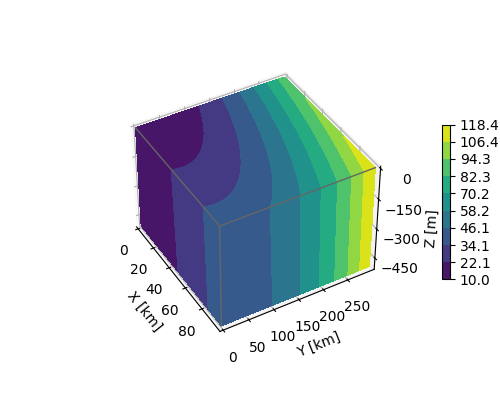
| Wed Feb 11 | 13.1 Introduction to Multivariable Functions | 1-31 [19, 23] | desmos level curves, level surfaces; Baker Preserve topo; matplotlib 3D box; Mathematica density | |
| Thu Feb 12 | Recitation: Groupwork: 12.2 #40, 44; 12.3 #20, 33, 37; 12.4 #11; 13.1 #12, 14, 18 | |||
| Fri Feb 13 | 13.2 Limits and Continuity of Multivariable Functions | 1-20 [13, 17] | desmos 2D limits | |
| 6 | ||||
| Mon Feb 16 | 13.3 Partial Derivatives | 1-34 [26, 31] | desmos partial derivatives | |
| Definitions of differentiability from 13.4 Differentiability and the Total Differential | 1, 2 | |||
| Wed Feb 18 | 13.5 The Multivariable Chain Rule | 1-30 [17, 19, 23, 30] | desmos chain rule | |
| Thu Feb 19 | Recitation: Test preparation | |||
| Fri Feb 20 | Test through 13.4 | (solutions) | ||
| 7 | ||||
| Mon Feb 23 | 13.6 Directional Derivatives | 1-28 [7, 13, 19, 25] | desmos gradient vector; desmos gradient and level curves | |
| Wed Feb 25 | 13.7 Tangent Lines, Normal Lines, and Tangent Planes | 1-24 [17, 21] | ||
| Thu Feb 26 | Recitation: Groupwork: 13.5 #9, 13, 19; 13.6 #17, 21, 27; 13.7 #5, 13 | |||
| Fri Feb 27 | 13.8 Extreme Values | 1-18 [12, 15] | ||
| 8 | ||||
| Mon Mar 2 | openstax 4.8 Lagrange Multipliers | 359-377 odd [367] | desmos Lagrange Multipliers, 2D example, 3D example | |
| Chapter 14 Multiple Integration | ||||
| Wed Mar 4 | 14.1 Iterated Integrals and Area | 1-22 [15, 19] | desmos bounds of integration I, bounds on integration II | |
| Thu Mar 5 | Recitation: Groupwork: 13.7 #23; 13.8 #9, 17; Openstax 4.8 #370, 374; 14.1 #15, 21 | |||
| Fri Mar 6 | 14.2 Double Integration and Volume | 1-26 [7, 23] | desmos double integral | |
| Spring Break | ||||
| 9 | ||||
| Mon Mar 16 | 14.3 Double Integration with Polar Coordinates | 1-16 [13] | ||
| Wed Mar 18 | 14.4 Center of Mass | 1-30 [20] | ||
| Thu Mar 19 | Recitation: Test preparation | |||
| Fri Mar 20 | Test through 14.3 | |||
| 10 | ||||
| Mon Mar 23 | 14.5 Surface Area | 1-19 [7, 11] | ||
| Wed Mar 25 | 14.6 Volume Between Surfaces and Triple Integration | 1-24 [7, 17] | desmos triple integral | |
| Thu Mar 26 | Recitation: Groupwork: TBA | |||
| Fri Mar 27 | 14.7 Triple Integration with Cylindrical and Spherical Coordinates | 1-44 [25, 33, 41] | (drop deadline with WP/WF) desmos spherical coordinate volume | |
| 11 | ||||
| Mon Mar 30 | openstax 5.7 Change of Variables in Multiple Integrals | 357-401 odd [385, 389, 393] | ||
| Chapter 15 Vector Analysis | ||||
| Wed Apr 1 | 15.1 Introduction to Line Integrals | 1-20 [15, 19] | ||
| Thu Apr 2 | Recitation: Groupwork: TBA | |||
| Fri Apr 3 | 15.2 Vector Fields | 1-18 [13] | 3blue1brown video: Divergence and curl | |
| 12 | ||||
| Mon Apr 6 | 15.3 Line Integrals over Vector Fields | 1-21 [11, 17] | ||
| Wed Apr 8 | 15.4 Flow, Flux, Green's Theorem and the Divergence Theorem | 1-24 [13, 17] | ||
| Thu Apr 9 | Recitation: Test preparation | |||
| Fri Apr 10 | Test through 15.3 | |||
| 13 | ||||
| Mon Apr 13 | 15.5 Parametrized Surfaces and Surface Area | 1-24 [7, 17] | ||
| Wed Apr 15 | 15.6 Surface Integrals | 1-14 [5, 7] | ||
| Thu Apr 16 | Recitation: Groupwork: TBA | |||
| Fri Apr 17 | 15.7 The Divergence Theorem and Stokes' Theorem | 1-24 [13, 17] | ||
| 14 | ||||
| Mon Apr 20 | Catch up | |||
| Wed Apr 22 | Catch up | |||
| Thu Apr 23 | Recitation: Groupwork: TBA | |||
| Fri Apr 24 | Recap/ Review/ Exam preparation | |||
| 15 | ||||
| Wed Apr 29 | Final Exam 10:10am-12:10pm in our regular classroom. | |||
Last modified: Wed Mar 4 13:01:32 UTC 2026